 Wellness Review Labs
 By
By 
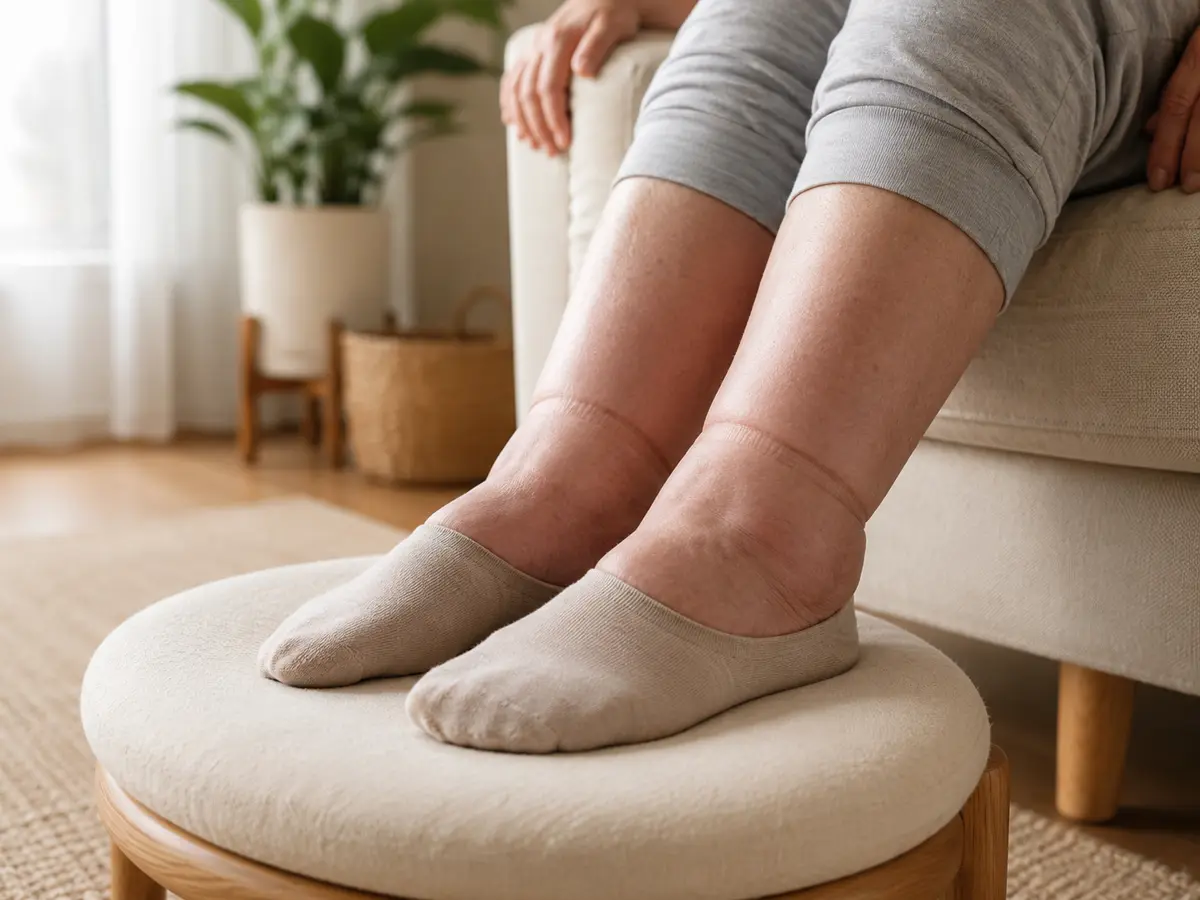
To tell the difference between swollen legs and normal legs, you can perform a simple five-second test. Press your thumb firmly into the skin over your shinbone or ankle. On a normal leg, the skin bounces back immediately, leaving no mark. On a swollen leg (a condition known as edema), your thumb will leave a visible indentation, or "pit," that takes several seconds or even minutes to disappear. Normal legs retain their natural contours around the ankle bones and tendons, while swollen legs often look shiny, stretched, or lose their structural definition.
The Visual and Physical Differences: Swollen vs. Normal
It is entirely normal for your legs to feel slightly heavier at the end of a long day, especially if you have been standing on hard surfaces or sitting at a desk for hours. However, there are distinct physical markers that separate normal daily fatigue from actual fluid retention.
In a normal leg, the skin is pliable and elastic. You can easily pinch a fold of skin on the top of your foot or near your ankle. The ankle bones are clearly defined, and the tendons running along the top of your foot are visible when you wiggle your toes. If there is any evening puffiness, it is minimal and disappears completely after a night of sleep.
In a swollen leg, excess fluid accumulates in the interstitial spaces—the tiny gaps between your cells. This causes the skin to look tight, smooth, or unusually shiny. The natural hollows around your ankle bones may fill in, making your lower leg look more like a straight column. You may also find that your shoes feel uncomfortably tight, or that your socks leave deep, itchy rings on your calves.
How Your Body Manages Fluid in Your Legs
To understand why legs swell, it helps to look at how fluid moves through your body. Your cardiovascular system pumps blood down to your feet, but getting that fluid back up to your heart is a major upward battle against gravity.
Your body relies on two primary drainage pathways to keep your legs looking and feeling normal:
- The Venous System: Your veins contain tiny, one-way valves designed to prevent blood from flowing backward. When you walk, your calf muscles contract, squeezing the veins and pushing blood upward.
- The Lymphatic System: This is your body's secondary drainage network. It collects excess fluid, proteins, and waste products that leak out of your blood vessels, filtering them through lymph nodes and returning them to your bloodstream.
If either of these systems becomes sluggish, fluid begins to pool in the lowest points of your body—your ankles and feet. This is why prolonged sitting or standing is the most common cause of temporary swelling; without your calf muscles acting as a pump, fluid naturally settles downward.
Everyday Factors That Cause Leg Swelling
Not all leg swelling is a sign of a medical emergency. Many everyday factors can temporarily overwhelm your body's drainage systems, leading to mild, reversible puffiness.
Dietary Sodium: When you eat foods high in salt, your body holds onto extra water to keep your blood chemistry balanced. This extra fluid volume often leaks into the tissues of your lower legs, causing temporary swelling.
Hot Weather: High temperatures cause your blood vessels to dilate (widen) to help cool your body down. While this keeps you from overheating, it also makes it easier for fluid to slip through the vessel walls into the surrounding tissue.
Inactivity: Whether you are on a long-haul flight, working a desk job, or recovering from an injury, lack of movement stops the "calf muscle pump" from doing its job. Fluid accumulates simply because it has no help moving upward.
Age-Related Changes: As we get older, the valves in our veins can naturally weaken, and our lymphatic vessels can become less efficient at clearing fluid. This makes temporary swelling more common as we age.
Free and Simple Ways to Support Fluid Balance
If your swelling is mild, temporary, and affecting both legs equally, there are several highly effective, cost-free habits you can adopt to help your body drain the excess fluid.
First, practice gravity-assisted drainage. At the end of the day, lie down and elevate your legs on a stack of pillows so they are positioned above the level of your heart. Do this for 15 to 20 minutes to allow pooled fluid to drain naturally back toward your torso.
Second, get your calves moving. If you must sit for long periods, perform simple ankle pumps: point your toes down, then flex them up toward your shins. Repeating this simple motion 20 times every hour wakes up your calf muscles and jumpstarts your circulation.
Third, try gentle dry brushing or self-massage. Using a soft-bristled brush or your hands, stroke your skin using very light, circular motions, always moving upward from your feet toward your groin. This mimics the natural rhythm of your lymphatic system and encourages fluid to move toward your lymph nodes for filtration.
Many people think they should drink less water when their legs are swollen, but the opposite is true. Staying well-hydrated helps your body flush out excess sodium, which actually reduces fluid retention.— Circulatory Health Educator
A Plant-Based Option: Linfaflow Lymphatic Support
For those who want to support their body's natural fluid clearance alongside lifestyle changes, a targeted supplement can be a helpful addition. Linfaflow is a plant-based liquid formula designed to promote healthy lymphatic circulation and support fluid balance from the inside out.
Delivered in easy-to-use liquid drops, Linfaflow is formulated with traditional herbs known to help support the body's natural waste-elimination and drainage pathways. Because it is a liquid, it absorbs quickly, offering a convenient way to supplement your daily routine.
It is important to be realistic about what dietary supplements can do. Linfaflow is designed to support healthy fluid dynamics and comfort in individuals experiencing mild, everyday fluid retention. It is not a treatment or cure for chronic medical conditions like deep vein thrombosis (DVT), severe venous insufficiency, or lymphedema. However, if you are looking for a natural, everyday tool to help keep your legs feeling light and comfortable, Linfaflow offers a gentle, plant-based option.
Linfaflow starts at $19.99 per bottle and comes with a 90-day money-back guarantee, allowing you to try it risk-free to see if it makes a difference in your daily leg comfort.

Linfaflow is a gentle, plant-based liquid drop option designed to support healthy lymphatic drainage and fluid balance for those experiencing mild, everyday leg puffiness.
- Buy 3, Get 3 Free — Lowest Price Ever$19.99/bottle
- Buy 2, Get 2 Free — Most Popular$29.99/bottle
- Buy 1, Get 1 Free$34.75/bottle
We may earn a commission at no extra cost to you.
Building a Daily Routine for Lighter Legs
The most effective approach to managing fluid retention is a consistent daily routine. Consider combining behavioral habits with natural support to get the best results.
Start your morning with a tall glass of water and a few minutes of light stretching or a brief walk to get your circulation moving. If your job requires sitting, set a timer to stand up and do ten calf raises every hour. In the evening, spend ten minutes with your legs elevated, perhaps while reading or watching television. By pairing these simple physical habits with targeted support like Linfaflow, you can help your lymphatic and circulatory systems keep up with the demands of the day, helping your legs stay feeling normal, light, and comfortable.